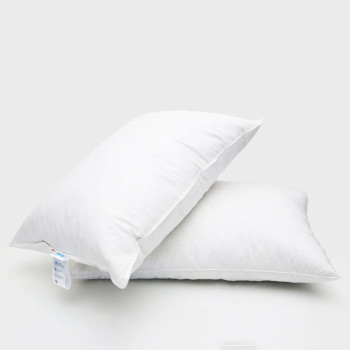
When we set out to create the perfect sleep experience, we knew that it would depend on one key factor — fabrics. The fabrics and materials chosen for sleepwear should have the power to relax the mind and soothe the body, inviting you to sleep every night and returning you to the world rejuvenated the next morning.
Whether it's for pillows and lightweight goose down duvets, or for pillowcases and sheets made of percale or cotton sateen, we select only the best natural fabrics for your comfort.
At Poohy, we mainly use three types of cotton fabric depending on their weave: Percale, Cotton Sateen and Twill. With this article, we will clarify the differences between them.
To put it simply and clearly, a cotton fabric is better when:
- There are between 90 and 150/160 threads per 1 cm²
- It is made up of single-ply threads (yarns)
- It is made of long-staple cotton
But to understand this more clearly, we need to dive deeper into the science of fabric weaving.
1. Types of woven cotton fabrics used by Poohy

Woven fabrics are produced on looms by passing threads (yarns) over and under each other lengthwise and crosswise. The lengthwise threads are called the warp, the crosswise threads are called the weft, and the sequence in which they are interwoven is called the weave. The type of weave determines the type of fabric.
We use three types of fabric to make our duvets, pillows and goose down mattress toppers: Percale (plain weave), Twill, and Cotton Sateen (satin or atlas weave).
- Percale – Plain Weave: the oldest, strongest and most widely used weave. It is created by the interlacing of one warp thread and one weft thread, which pass alternately over and under each other. A clean, fresh and classic fabric that only gets nicer and softer with time and every wash. Recommended if you tend to get hot at night — it is light, breathable and cool to the touch. Percale is also the preferred fabric for making duvets, pillows and goose down mattress toppers due to its strength and ability to be woven very tightly, keeping the down firmly inside.
- Twill: softer and more flexible than percale plain weave, it is the preferred weave for making goose down and feather pillows. An interesting fact is that denim is also made from twill, but with different threads. In twill, the weft passes over two warps, creating a fine diagonal pattern through the fabric. Our favourite pillow model, the Poohy Double Down, is made with this type of fabric, which also features a special surface treatment for softness called Dream Touch.
- Cotton Sateen: the most complex and spectacular weave, producing a shiny, brilliant fabric. The weft passes similarly to twill, but over more than two warps. It is most widely used for bed linen, pillowcases and sheets. The fabric is luxurious and very smooth against the skin — recommended if you tend to feel cool at night and are looking for a silky, indulgent feel.
2. Thread count

Thread count is a factor that determines the quality of cotton fabrics used both for bed linen and for the production of goose down pillows and duvets.
Thread count refers to the number of threads woven together in 1 cm² (or 1 in²).
Higher quality fabrics typically have between 90 and 150 threads per 1 cm² (or between 220 and 400 threads per 1 in²), with the gold standard for quality being 110 threads per 1 cm². To achieve a higher thread count, thinner threads are used — and thinner threads are produced from longer-staple, better-quality cotton.
The more threads per cm², the softer, denser and more durable the fabric. However, exceeding 150 threads/cm² can be misleading — multi-ply threads are often used and each individual layer is counted as a separate thread.
The same principle applies to goose down fabrics — the fabric becomes denser as thread count increases, improving its ability to keep down and feathers inside. However, a study by the International Down and Feather Research Laboratory (IDFL) found that thread count alone does not always determine a fabric's ability to retain the filling, and the best results are achieved with fabrics of 90 to 150 threads per cm².
3. Single-ply and multi-ply threads

A thread (or yarn) is made up of cotton fibres twisted together. Single-ply threads have only one layer of fibres twisted in one direction, while multi-ply threads have several layers (usually 2 or 3) twisted together into a single thread.
To achieve thread counts above 150 per cm², some weavers use lower-quality cotton to make multi-ply threads, counting each layer as a separate thread. Single-ply threads are made from longer-staple, higher-quality cotton, while multi-ply threads use weaker fibres twisted together to create a deceptive strength — the resulting fabric becomes thicker, coarser and heavier.
Poohy uses only fabrics made from single-ply fibres and long-staple cotton.
4. Long-staple cotton and the finest threads
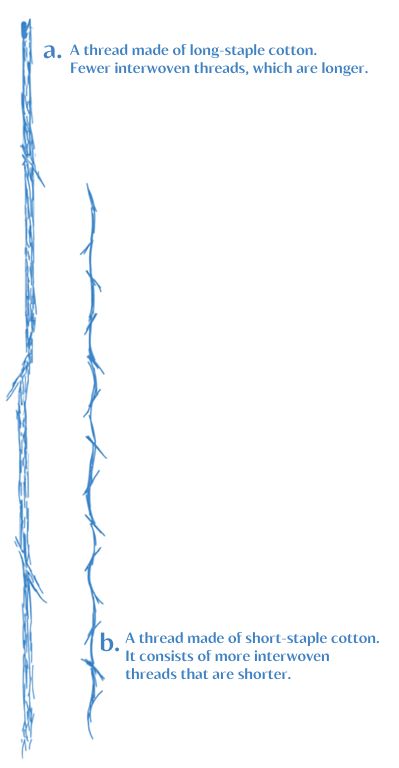
With cotton, longer is better. Long-staple cotton produces the longest, strongest and finest cotton fibres in the world. Longer fibres can be spun into stronger, finer yarns, producing exceptionally smooth and soft fabrics. Shorter fibres can work loose during weaving, resulting in a coarser, weaker fabric.
Fine thread spun from single-ply long-staple cotton is responsible for the most luxurious fabrics for your bedroom. The finer the thread, the smoother, lighter and softer the resulting fabric.
By using only single-ply long-staple cotton, we are able to create our products using 40, 60 and 80 count threads — the finest available for making cotton bed linen.
Now you can make the best and most informed choice when selecting duvets and pillows.
Sweet dreams with #POOHY!